


?`s and ANNEswers

Ten minutes to write. Less time to read.

Stonehenge

Originally published February 21, 2006

Stonehenge, that massive pile of carefully laid stones in the downlands of England, has been a source of speculation and admiration for generations. I remember first learning about it in some elementary school social studies class where the teacher hinted that the monument was originally built by druids.

Of course, she was wrong, just as those who claimed the Celts, the Romans, the Egyptians, and even King Arthur built it. The truth is nobody really knows who the master planners were. What is accurate is that Stonehenge took extraordinary effort to create almost five thousand years ago, and it is presumed today that such effort was for a specific, perhaps religious, purpose.

I have always been intrigued with Stonehenge. As a student, photos of it in history books were sure to draw my attention. Perhaps that’s why, when I was arranging my preferences on my new computer, I chose the icon to be displayed on as my desktop whenever my files were all minimized or closed. I love looking at the circle of rough-hewn stones rising upward toward a swirling Van Gogh sky.

I visited Stonehenge only once, in the late nineteen eighties. At the time, I was surprised at how small the area was in real life and thought that photos of it had given a grander impression. Truthfully, they only did it justice. It’s not so much the size as the mood that strikes you.

I understand the years since my visit have been less than kind to Stonehenge. A big highway roars by now and a circus has set up its tent not far away. I’m not sure I’d want to go there. But I still admire those ancient stones and still get that feeling of awe every time I see my monitor’s desktop in repose.
Leave a comment

Vodka

Originally published January 25, 2006

My evening cocktail of choice is vodka on the rocks.

It wasn’t always this way. When I first became legal and could order a drink with my ID as collateral, I chose Pink Ladies. They were syrupy and smooth and pink; and I’m not sure anyone knows how to make them nowadays.

As time passed I graduated to Green Frogs, various wines, old fashioneds, lite beer, wine coolers, back to beer, and finally vodka. My vodka affection stems from 1992, when I attended a banquet with a friend. He had to work that evening, so I was on my own with a table full of guests I didn’t know. One of the gentlemen there asked what I’d like to drink, and out of the blue I said, “Vodka, please, with two limes.”

Don’t ask what possessed me, as I have never known. However, it’s been vodka, please, with two limes ever since.

I’m still no connoisseur, but as a general rule I order Absolut® in a restaurant because nobody can screw up that request. I often drink it at home too, although Michigan liquor prices are exorbitant; and whenever I resent paying them, I resort to less expensive stuff.

My neighbor, Clara, claims there is no difference between cut-rate priced Popov® and my beloved Absolut®. In fact, one night she invited me over for cocktails and offered a sampling of three vodkas, with crackers to eat in-between each test. I sipped them all, rolled each around in my mouth, and eventually proclaimed the one I believed to be Absolut®. When I looked under the cocktail glass to read what I’d really chosen, it said, “Popov®”

Which just supports my contention that I’m no connoisseur.

Leave a comment

New York City

Originally published November 9, 2005

There is no place in our country like New York City. I haven’t been to all the major metropolises of the world, so I hesitate to say New York is the top of the tops; but I wager it’s a contender.

As someone who’s spent part of her childhood in New York and much of her adult life in and around Chicago, I feel qualified to make comparisons. Sorry, Chicago, if it doesn’t always work in your favor.

When you arrive by plane, New York City’s skyline dwarfs Chicago’s. When you find a taxi to go to your hotel, the traffic makes Chicago’s look like a drive in the country. When you seek diversity, New York is a little United Nations, while Chicago is a littler one. New York is faster, smarter, cleverer, trendier than her Midwest counterpart will ever be.

At the same time, here are some things Chicago offers that New York doesn’t.

Through some divine planning, the Windy City has alleys, while the Big Apple doesn’t. This may not sound like much, but when it’s garbage collection day in your neighborhood where would you rather have your leftover food, your disposable diapers, and your beer cans waiting to be picked up? In the alley or on the street in front of your house or apartment?

I thought so.

Chicago is driveable, while New York City really isn’t. The Dutch founded the original island in the seventeenth century with fewer than one thousand residents — you do remember the story about the Indians selling Manhattan for a handful of trinkets? — so who’s to argue that the layout of the streets precluded the automobile?

For the record, Chicago wasn’t founded until the early nineteenth century; and, granted, the automobile was still years away from invention. However, Chicago never was an island with limited space; rather it subscribed to the endless prairie theory.

Fortunately, I don’t have to choose between either city. Rather, I live in bucolic southwestern Michigan, which makes both cities seem world-class. And, for the record, I’m really happy to have experienced life firsthand in each.

Leave a comment

Passion

Originally published October 19, 2005

According to Mr. Gay Hendricks, author of A Year of Living Consciouslyё your passion is something you do that makes you lose track of time. It is so fulfilling that it never feels like work. Since reading Hendricks’ theory, I’ve thought about what my passions might be. What do I lose myself in? Taking it further, what makes a day feel complete?

It’s fair to say my passion clusters around two primary activities: creating and organizing. And I manifest each in a variety of ways.

Take creating. I’m always tinkering with words, trying to learn piano, working on a crocheting project, and attempting a new recipe. All of these are creative endeavors in my book, especially because I cannot leave written instructions alone. When the piano piece calls for a certain key, I’m prone to play its sharp or flat cousin. When a recipe calls for something I don’t like or stock, I choose a substitute. It’s a given that I need to add, subtract, or otherwise alter to make something my very own. (This is not to say that everything I change turns out for the better.)

Take organizing. I’m always grouping, planning, managing people, data, and ideas. Who knows, maybe I’m just a meddler; but I love to structure plans and projects so that they run smoothly. On time and in budget, as the current saying goes. (Again, I don’t always succeed.)

The truth is my days fly by. I suspect some of this is due to age, but I’m hoping just as much is due to my filling the time with passion instead of obligation. If your days don’t fly by, maybe you want to evaluate what’s missing.

Leave a comment

The Think Method

Originally published August 30, 2005

Professor Harold Hill of “The Music Man” fame and I have a lot in common. We both believe in the think method of music. Of course, there is one difference between us: my method works, at least for me, and his was a scam artist’s dream.

If you’ve seen the Meredith Wilson musical, you know that Harold Hill entices the people of Gary, Indiana, to purchase musical instruments with which to create a brass band for their young. It doesn’t matter than finding teachers or conductors for the band is a crucial element for success; nor does it matter that it takes great time and patience to weave a uniform sound from discordant musicians. Hill subscribes to the think method of music; that is, if you think the tune, you can play it. Basically, he’s out to sell instruments and then skip town.

I’m not planning on skipping town.

But I do use a variation of the think method when it comes to practicing for my weekly piano lesson. Case in point. This week I’m to practice a simple C major piece whose melody moves from the left hand to the right and back again. It’s different from most of the pieces in my lesson book, because they have chords in the left hand and the melody in the right. And I’m a whiz at chords in the left with melody in the right.

So I approached this week’s homework with skepticism, assuming it would be difficult. At the same time, I also approached it from a thinking point of view whereby I spent the first couple days imagining how my fingers might approach such a difference in style.

And it worked. I managed to move from left to right and back again without getting too offbeat. I managed to pretend that my two hands were really one giant hand that hit notes from the F below Middle C to the A above it. And I managed to think of Harold Hill, the music man, and give him some slight credit. After all, if it weren’t for him, I might never have considered the think method.

Leave a comment

Thoughts on the Weekend

Originally published June 4, 2004

It is Friday, June 4, 2004, and we are heading into the weekend. But not just any weekend; it is my birthday weekend. Mine and the birthday of the invasion of Normandy, which occurred on June 6, 1944, within hours of my birth in the early morning hours of June 7.

All through my life, D-Day and my birthday have coincided. When I was little my Mother often said, as my birthday approached, “You were born the day after D-Day,” as if this were some special recognition.

Even my father, whom I did not meet until I was forty-eight, told me that he and my Mother sat up all night listening to the radio and learning of the invasion on June 6. The next day, they were coping with their own invasion.

Early on, I didn’t see the connection, but as time passed I began to reevaluate what it means to have a birthday on the day after D-Day. Not just a birthday on the anniversary of the day after D-Day, but the actual event.

A few years back, my Aunt Alice found and sent me a copy of the front page of the New York Times for June 7, 2004. It contained the first reports of what happened on those beaches and in those important beach towns. The main headline reads: “Hitler’s Sea Wall is Breached, Invaders Fighting Way Inland; New Allied Landings are Made.” Not surprisingly, there was no mention of my birth.

Currently this newspaper is framed and hangs in my office to remind me that, while I love birthdays more than Valentine’s Day or Christmas, men lay dying while I was being born. There is a connection here after all.

This particular year D-Day and I both turn sixty. I’m pleased that much is being made of the remaining veterans from that conflict, who are dying at the rate of approximately one thousand a day. I’m also pleased that Earl, his daughter, and son-in-law have gone to great lengths to hold a party in my honor. I feel grateful that all of us — ancient soldiers and an aging woman — are all being remembered together.

Leave a comment

Long Division Without a Calculator

Originally published August 21, 2005

Recently the thought for the week on my web site asked, “Does anybody remember how to do long division without a calculator?” Nobody actually responded to this question, so I’m drawing my own conclusions. And the truth is I think there are many of us out there who do indeed remember learning how to do long division and then dreading the homework that followed.

Long division introduced itself to me around fourth grade. It came after intense study of addition, subtraction, multiplication, and the multiplication tables. I went to a school that was big on memorization and we spent weeks learning about two times two, five times five, and ten times ten. We learned every combination in-between too, forwards and backwards. Little did I realize we were being prepped for that most difficult of basic math functions: gozinta. That’s what we called long division back then.

When we finally began our study of LD, we started with simple problems, like three gozinta twelve how many times? But this exercise soon blossomed into problems where the numbers were much larger and there were remainders. It often took half a sheet of paper to demonstrate the answer.

Today, calculators do the entire thing. You just plug in the numbers and wait for the answer. There is no mental math involved. There is no emphasis on memorization or the time-honored multiplication tables. Instead, the focus seems to be on how to master a mechanical tool that does the work for us.

By doing this, we’re not teaching our children mathematical capability; rather, we’re teaching them how to use a calculator to find the answer. It’s mechanical manipulation over mathematical reasoning. The answer is the same, but the process has definitely changed.

Do I think calculators are bad? No. I think they have their place, but it definitely falls in line behind teaching children the basics of math. Once somebody has mastered them, I have no problem with that person taking a short cut. It’s only when the shortcut becomes the honored way of thinking that I wonder about our mental acuity.

Leave a comment

Lightning Bugs

Originally published June 26, 2005

They’re God’s flashlights or Tinkerbell’s dearest friends. So why do children capture them and put them in jars? On the face of it, it seems cruel.

But I think it’s because lightning bugs – also known as June bugs because they appear most prolifically in June – are ephemeral and fleeting. So it’s important to catch them and hold them dear. It’s about cherishing and not about imprisoning.

Lightning bugs surround our house every June, emitting their bright signals and flitting from here to there. It’s an enchanting thing. We sit on the deck or the patio and are surrounded by little lights, some in front of our noses and others in the flowerbeds.

While Earl and I don’t have any children of the age where jars of Junebugs beckon, we still have the ardor it takes to admire both the lightning bugs and their pursuers. At this age, we imagine what it would be like to have little ones romping on the lawn and chasing the lightning bugs at the same time that we’re admiring the bugs for their incandescence and thanking them for making their annual appearance.

Leave a comment

Oldest Book

IMG_20160604_162749
Originally posted September 20, 2004

I own five or six hundred books at most, since I’m not as interested in owning as reading them. I’m prone to recycling with friends, giving to the Salvation Army, and generally keeping books I might have to move to a manageable level.

But yesterday afternoon I wondered what book I have held onto the longest. Which one had followed me more places than any other? It isn’t something one can positively determine from the publishing date; rather, I looked for inscriptions on the flyleaf from the books’ givers. In the meantime, I was rewarded with a variety of memories about the givers themselves.

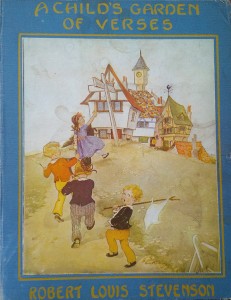
The book that took the title of having hung around the longest belonged to Robert Louis Stevenson, he of Treasure Island and Dr. Jekyl and Mr. Hyde fame. This book, called A Child’s Garden of Verse, was published originally in 1885.

From the handwriting on the inscription, I see that my maternal grandmother, Anna Catherine Bannon McDonald, gave me this book in 1950, when I was a mere six years old. I also see the scribbles I put around her words, as if I were decorating them while learning cursive in second grade.

Given its age, A Child’s Garden of Verses is in remarkable condition. The hardback cover is a bit ragged, but the spine holds strong. The illustration on the front is faded, but still recognizable. And inside are the poems that R. L. Stevenson wrote almost 120 years ago. I enjoy them still, and I enjoy as much the fact that my grandmother, who has joined Stevenson on the other side, thought enough to add her own dedication over half a century ago.

Leave a comment

Why 10 Minutes?

Originally published June 11, 2004

Hey, Natalie Goldberg, you are responsible for this blog; you and your book, Writing Down the Bones, which I read years ago. I’m still trying to practice your directive to sit somewhere and write without editing for ten minutes a day. Write as if you really had something to say and had to commit it to paper before any more time passed. Write as if commas and misspellings and pronouns didn’t matter.

Your original advice was to take pen to paper for that special ten minutes, and I did that for a couple years, filling more than one of those blank books that are popular. I wrote and wrote. It wasn’t about journaling as much as it was about sweeping the cobwebs from one’s creative core, so some selections went this way while others went that. Public issues, private thoughts, fiction, reality are all grist for the creativity mill.

Perhaps you think writing ten minutes a day on a computer is cheating. I know, I know. You can delete, copy and paste, and do all sorts of things more quickly, thus sabotaging the real purpose of the exercise. But I want to tell you that I’m being true to your advice.

I write without mulling over each word, examining each sentence, or considering the value of any given paragraph. I decide on my subject, set my timer, and let my fingers goes.

When the typewriter was invented, perhaps there were writers who thought creating an essay or a book on this new contraption wasn’t writing. And perhaps there are purists who feel that way about working on a computer. But, Natalie, we have to change with the times if we want to keep up. So I’m practicing my ten minutes online.

Maybe one of these essays will catch your eye and you’ll know I’m still true to what you taught me.

Leave a comment